Sustainability
We are an integral part of society and believe that responsible business creates value for customers, employees, and the wider community alike. Therefore, we are committed to contributing purposefully and thoughtfully to sustainable development by operating in a sustainable and environmentally conscious manner. In setting our sustainability goals, we are guided by ESG principles, international best practices, and the European Union’s sustainability objectives and policy directions.
It is important for us to build a sustainable aviation together and for the next generations. We want to raise interest of young people in the field of air navigation. In addition to air traffic controllers, the aviation of the future also needs engineers and IT specialists. We work with schools and universities and support educational projects that have positive impact in our business area.
We value long-term cooperation and support initiatives that help us to develop safe and environmentally sustainable air navigation industry.
EANS Sustainability Principles
EANS’ sustainability principles guide our sustainability-related activities and help us make informed and responsible choices in our daily work. In our activities, we are guided by the understanding that we increase the positive impact of our operations on society and the environment, while reducing negative environmental and climate impacts.
Our approach to sustainability is based on three areas:
- responsible and systematic management;
- people’s well-being, safety and an inclusive working environment;
- efficient use of resources and the prevention and reduction of environmental impacts.
Responsible management and value chain
- We raise awareness of responsible choices and sustainability-related impacts, set an example in implementing sustainability principles, and communicate our activities clearly and transparently.
- We cooperate with partners and organisations to share knowledge, develop sustainable practices and support the development of the sector.
- In people management, we follow EANS’ people management principles.
- We are guided in our work by the Code of Ethics.
- We expect responsible behaviour from our partners and take this into account in cooperation decisions. We avoid cooperation with individuals and organisations whose activities are contrary to our security, legal or value framework.
- We take sustainability principles into account when planning our activities and making decisions in a way that supports the safe, efficient and environmentally conscious management of air traffic.
People’s well-being and work culture
- We maintain balance. We plan our time and activities so that workloads remain reasonable and mental and physical well-being is supported.
- We value and maintain direct communication. Face-to-face meetings help support good cooperation and a sense of belonging.
- We take short breaks during the day. Resting the eyes and doing a brief stretch help maintain fresh thinking and well-being.
- Where possible, we hold walking meetings. Movement and fresh air help ideas take off and thoughts flow. When organising and participating in meetings, we follow our Good Meeting Practice.
- We support employees’ continuous development and self-improvement. We follow EANS’ people development principles.
- We encourage knowledge sharing and cooperation within the organisation.
Responsible consumption and resource use
- Where possible, we prefer borrowing, renting and reused solutions.
- We make well-considered procurement decisions and avoid overconsumption. We encourage the participation of solutions and partners that support sustainability goals in procurements and cooperation, and prefer them in our choices where possible.
- We use digital solutions responsibly, keep our digital environment organised and keep pace with relevant digital developments.
- We use products and materials as efficiently as possible and, where possible, redirect them for further use.
- We save energy, water, paper and other materials.
- Where possible, we prefer paperless administration.
- When printing, we use double-sided and black-and-white printing where possible and reuse paper.
- We use room lighting in an energy-efficient way, including switching off lights when leaving common areas (e.g. meeting rooms, toilets).
- We notice and report unnecessary resource use or technical problems.
- We maintain a reasonable indoor temperature in office spaces — our usual comfort range is +21 to +23 °C.
- We drink and offer tap water.
Reducing environmental impacts
- We reduce waste generation and prefer reuse.
- We sort waste by type and collect hazardous waste separately.
- Where possible, we avoid using single-use products and tableware.
- We consciously choose the form of participation — if a meeting or event creates the greatest value on site, we participate in person; otherwise, we prefer digital solutions.
- For business trips and events, we assess both time use and environmental impact.
- When travelling for business trips and events, we prefer public transport or other environmentally friendly modes of transport.
Contribution to society
- We share our knowledge and experience, contributing to public discussion and the development of the sector both in Estonia and internationally.
- We cooperate with educational institutions and professional organisations to support the next generation and develop sectoral knowledge and skills.
- We support the communities we are connected to and act in a way that takes into account the impact of our activities on the surrounding environment and people.
EANS value chain and double materiality assessment
In 2025, we carried out an assessment to better understand the impact we have on sustainability topics and what external risks and opportunities may affect the company. The work began with mapping our value chain, taking into account the specific nature of EANS.
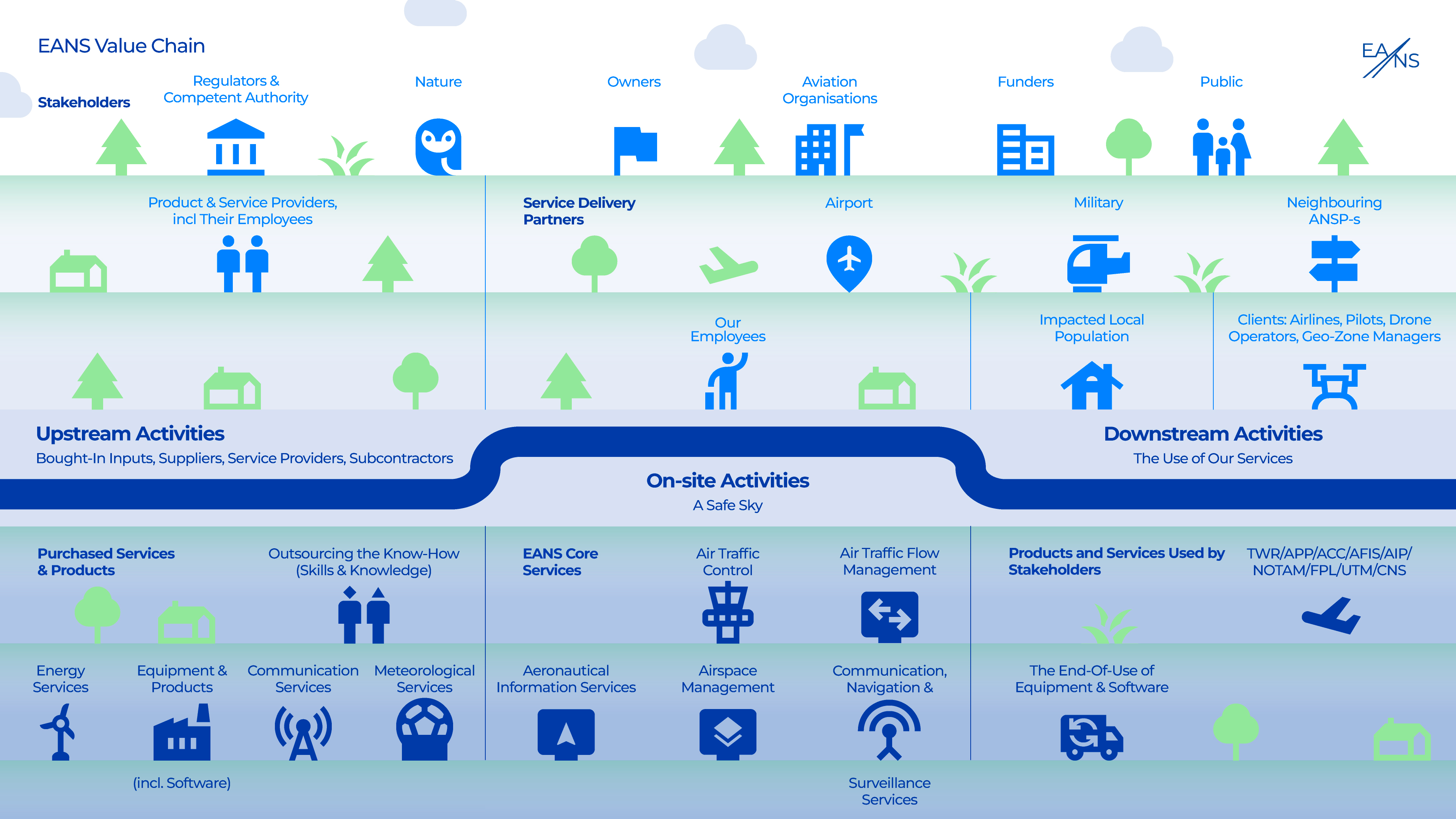 We involved both internal and external stakeholders in the assessment. The ESG working group and department heads participated directly. Among external partners, we conducted a survey in which 60% of those invited took part — demonstrating strong interest in the company’s sustainability topics. In addition, we gathered input from the owner and clients.
Based on the feedback received, we refined the assessments and validated the results together with department heads, assessing both current management practices and areas where we could take additional steps.
As a result, a clear overview emerged of EANS’ most material sustainability topics:
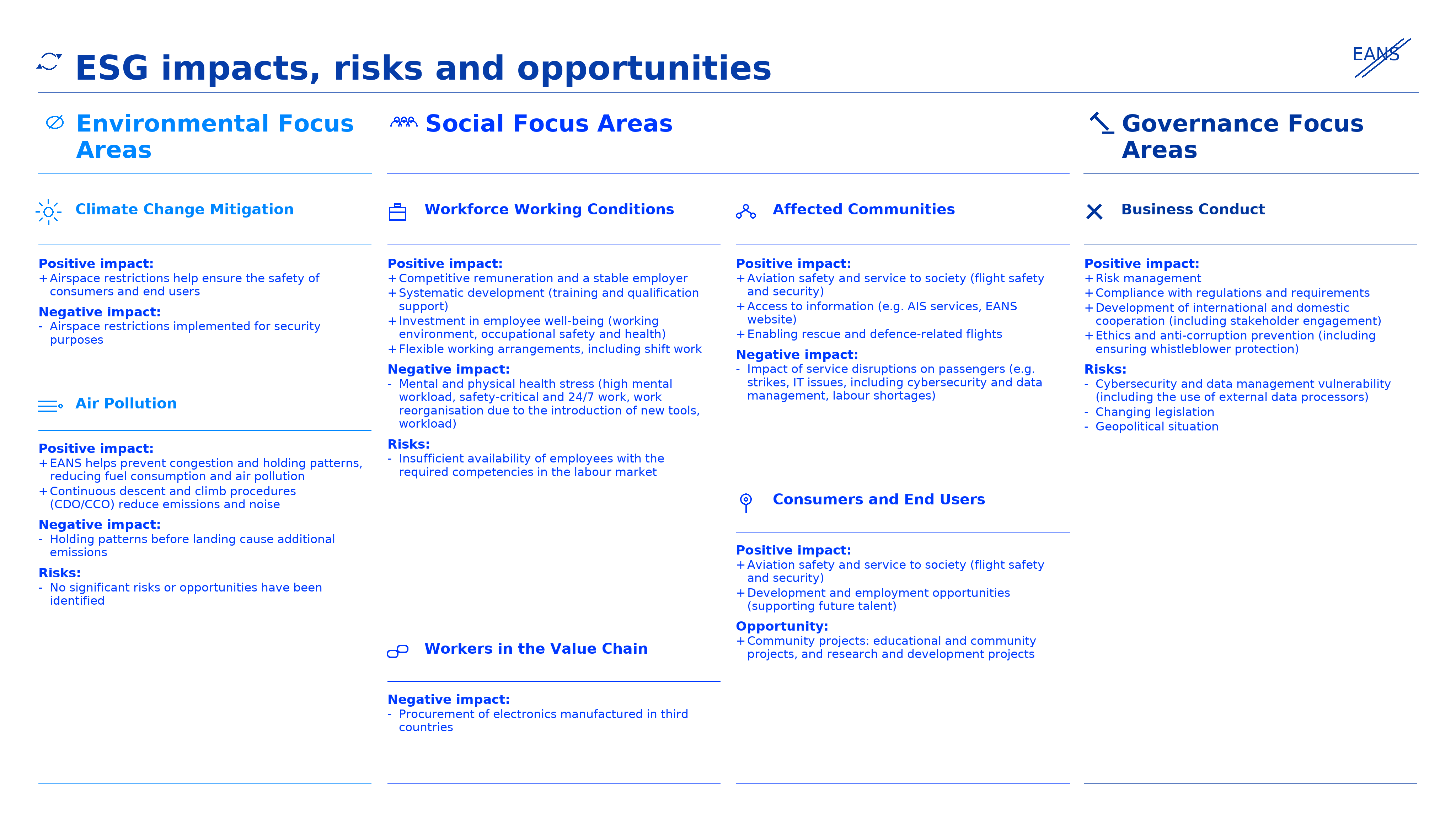
Most of these are already part of our strategies and daily work, especially in relation to social and governance topics. However, the assessment process brought the environmental dimension more clearly into focus — for example, the potential negative impact related to holding patterns was identified, which had not previously been addressed sufficiently. Overall, it became clear that due to the specific nature of our field of activity, there are few financially material risks and opportunities, but the identified topics continue to require attention and systematic management.
The company’s climate impacts
In 2025, we measured our climate impacts across all three scopes (Scope 1–3). We had already started collecting Scope 1 and 2 data in 2024, but in 2025, Scope 3 — detailed mapping of indirect impacts — was included for the first time. For Scope 3, we will be able to expand the existing categories and improve data accuracy over time, but the important first step towards mapping our overall climate impact has now been taken.
EANS GHG emissions by scope:
- Scope 1 — direct emission sources, such as company-owned vehicles, backup generators, and fugitive emissions leaks.
- Scope 2 — indirect emission sources arising from purchased electricity.
Scope 3 — other indirect emission sources, such as employee business travel, commuting, and purchased goods and services.
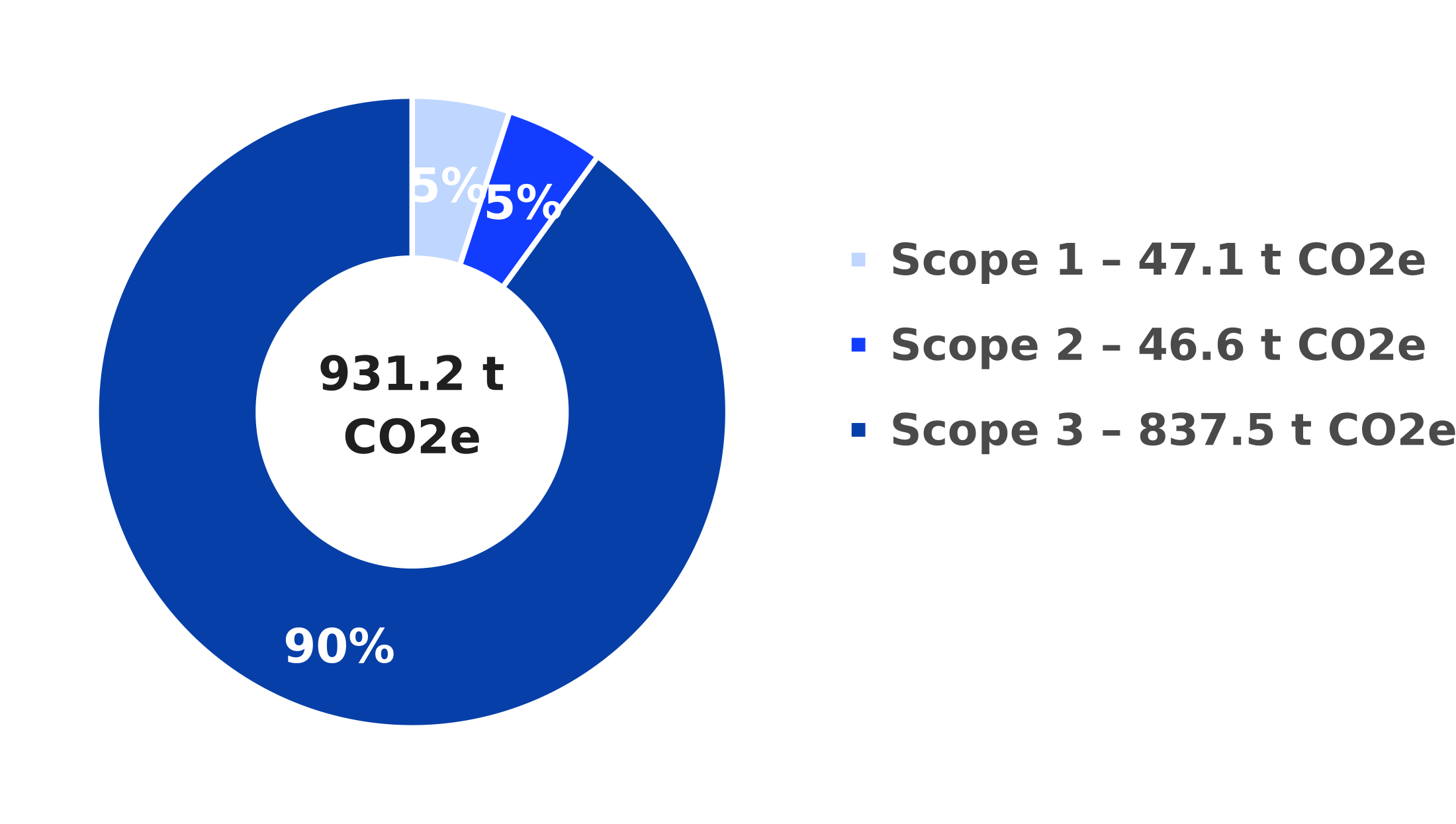
Climate impacts have been calculated based on 2025 data